Thursday, January 14, 2021

SCOTUS: City can retain impounded property despite Bankruptcy automatic stay - Chicago v. Fulton (01/14/2021)

Balls and strikes...is it the right metaphor even in the most mundane sounding technical issue..what did Congress intend in enacting the "automatic stay" of 100 days of creditors actions upon the filing of a bankruptcy petition?
The difference in how judges view such question in the abstract seems to be simple umpiring.  But perhaps the consequences should be considered. 
Who, after all, gets their cars impounded for non-payment of parking tickets?  Few lawyers and law professors suffer that fate.  So in this case Samuel Alito delivers the balls and strikes opinion while Sonia Sotomayor tells us what the impact is on people like respondent George Peake whose car with 200,000 miles on the odometer was impounded and not released to him by the City of Chicago. - GWC
19-357 Chicago v. Fulton (01/14/2021)
JUSTICE ALITO delivered the opinion of the Court. When a debtor files a petition for bankruptcy, the Bankruptcy Code protects the debtor’s interests by imposing an automatic stay on efforts to collect prepetition debts outside the bankruptcy forum. Ritzen Group, Inc. v. Jackson Masonry, LLC, 589 U. S. ___, ___–___ (2020) (slip op., at 6–7). Those prohibited efforts include “any act . . . to exercise control over property” of the bankruptcy estate. 11 U. S. C. §362(a)(3). The question in this case is whether an entity violates that prohibition by retaining possession of a debtor’s property after a bankruptcy petition is filed. We hold that mere retention of property does not violate §362(a)(3). ***

JUSTICE SOTOMAYOR, CONCURRING:
***As a result, Peake’s car remained in the City’s possession for months. By denying Peake access to the vehicle he needed to commute to work, the City jeopardized Peake’s ability to make payments to all his creditors, the City included. Surely, Peake’s vehicle would have been more valuable in the hands of its owner than parked in the City’s impound lot.
***Peake’s situation is far too common. Drivers in low-income communities across the country face similar vicious cycles: A driver is assessed a fine she cannot immediately pay; the balance balloons as late fees accrue; the local government seizes the driver’s vehicle, adding impounding and storage fees to the growing debt; and the driver, now without reliable transportation to and from work, finds it all but impossible to repay her debt and recover her vehicle. See Brief for American Civil Liberties Union et al. as Amici Curiae 11–16, 31–32. Such drivers may turn to Chapter 13 bankruptcy for a “fresh start.” Marrama, 549 U. S., at 367... But without their vehicles, many debtors quickly find themselves unable to make their Chapter 13 payments. The cycle thus continues, disproportionately burdening communities of color, see Brief for American Civil Liberties Union et al. as Amici Curiae 17, and interfering not only with debtors’ ability to earn an income and pay their creditors but also with their access to childcare, groceries, medical appointments, and other necessities.  

Clearly, Josh Hawley, Ted Cruz didn't pay attention in law school

Clearly, Josh Hawley, Ted Cruz didn't pay attention in law school

With their phony legal arguments and pandering to Trump's baseless claims, Cruz and Hawley's bad behavior sets a bad precedent.

William N. Eskridge Jr.
Opinion contributor

As Sen. Mitt Romney (R-Utah) said, accountability for the Jan. 6 invasion of the Capitol to disrupt Congress’s Electoral College count rests not only with President Donald Trump, but also with those who “object(ed) to the results of a legitimate, democratic election.” Romney was referring to, among others, Sens. Josh Hawley (R-Mo.) and Ted Cruz (R-Texas), both alumni of my Legislation classes at Yale and Harvard Law Schools.

The Ivy Leaguers irresponsibly magnified the president’s baseless claims of widespread voter fraud — but they tried to deepen that bogus indictment by pandering to those who "believe the election that just occurred, quote, was rigged," as Cruz put it, and with smart-sounding legal arguments criticizing judges and the legal process. They know the process worked normally because I taught them how the process works. Neither had a single constitutional or statutory point that had not been examined and rejected by a bipartisan bevy of judges and administrators.

Pennsylvania law under siege 

The keystone state was Pennsylvania, where Hawley and Cruz were two of seven senators (along with 138 House members) voting to sustain objections to the lawfully chosen Electors. The congressional objectors largely avoided claims of fraud. Instead, they maintained that the rules followed in the Pennsylvania election were legally invalid. Their arguments disrespected the legal process established by the Constitution and statutes and interpreted responsibly by judges.

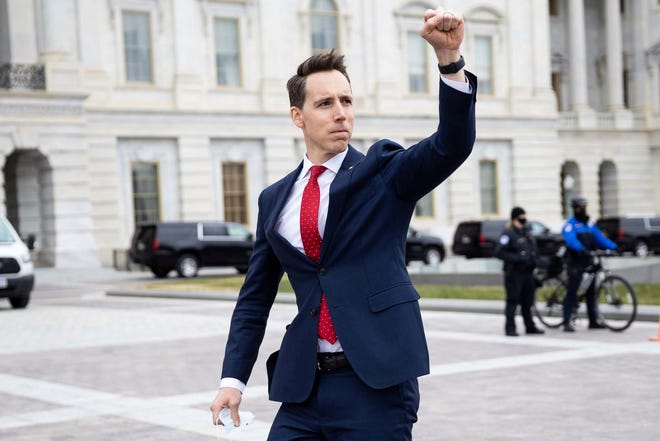
ONE TIME USE 1/7/2021 Sen. Josh Hawley (R-Mo.) gestures toward a crowd of supporters of President Donald Trump gathered outside the U.S. Capitol to protest the certification of President-elect Joe Biden's electoral college victory Jan. 6, 2021 at the US Capitol in Washington, DC. Some demonstrators later breached security and stormed the Capitol.

Sen. Hawley maintained that Congress was the proper forum for registering concerns about whether the Pennsylvania legislature’s 2019 law expanding mail-in voting violated the state constitution. Adopted by the GOP-dominated legislature, the law had never been challenged until after the 2020 election. 

Trump's Twitter ban:Trump can't be silenced, even by Facebook and Twitter, but we can prevent another Trump

On Nov. 28, 2020, the Pennsylvania Supreme Court unanimously ruled in Kelly v. Commonwealth that the post-election challenge came too late. Permitting the challenge would disenfranchise millions of voters who had relied on the law, a point also made by Trump-appointed Judge Stephanos Bibas in a related federal lawsuit. At no point in American history has a state or federal appellate court retroactively disenfranchised a state’s electorate in a presidential election for such a reason. 

Phony legitimacy to fraud claims

Republican House members picked up where Hawley’s argument collapsed: They claimed that the Pennsylvania secretary of State and Supreme Court had “usurp(ed),” as Rep. Fred Keller (R-Pa.) put it, the role of the legislature when they interpreted the 2019 law to allow three days for mail-in ballots to arrive.

In Pennsylvania Democratic Party v. Boockvar, the Pennsylvania Supreme Court applied the statutory timetable for mail-in ballots to a COVID-saturated environment and in light of the Post Office’s announcement that mail deliveries would be delayed. Following legislatively enacted canons of statutory interpretation, including an admonition that courts should apply statutes to avoid constitutional problems, the Court found a “legislative intent” to allow flexibility under emergency circumstances.

Impeach and convict:Trump doesn't deserve post-presidential benefits. Remove him and ensure he won't get them.

As my former students Cruz and Hawley know, statutory interpretation following the established rules is not an example of “usurpation." Led by Chief Justice John Roberts, for whom Hawley clerked, the U.S. Supreme Court twice rebuffed Republicans in Boockvar.

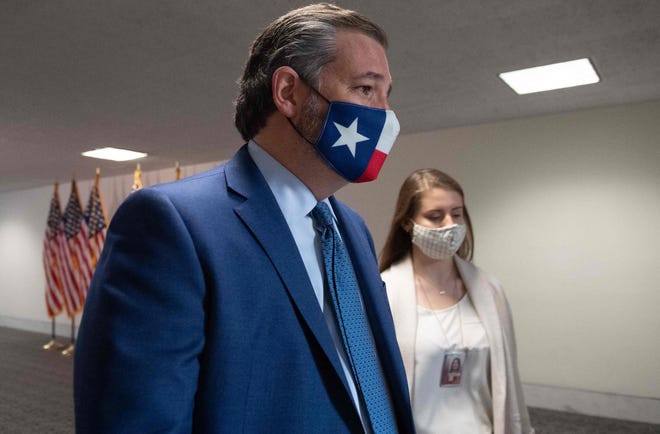
Sen. Ted Cruz, R-Texas

What point was served by the congressional rehash of frequently litigated and universally unsuccessful legal objections to Pennsylvania’s process? Sens. Hawley and Cruz made virtually no constitutional or statutory arguments that had not been rejected by Republican as well as Democratic judges. Neither they nor the House objectors revealed any literacy in the state constitution or its statutory interpretation code. Their press releases and speeches lent phony legitimacy to the president’s incendiary claims — claims that resulted in bombs near Capitol Hill and a historic insurrection that may be connected to at least five deaths.

Their bad behavior set a bad precedent for Congress, which has never second-guessed state electoral procedures so thoroughly vetted by the judicial process. 

Henceforth, sore losers in future elections may feel free to relitigate election-year lawsuits. Congress’s presidential vote-counting, which was once a ritual marking the peaceful transition of authority, might become another trench in hyperpartisan warfare or, worse, a quadrennial opportunity to delegitimize our democracy.

William N. Eskridge Jr. is the John A. Garver Professor of Law at the Yale Law School.  His most recent book is "Marriage Equality: From Outlaws to In-Laws" (Yale Press 2020) (co-authored with Christopher Riano).

Wednesday, January 13, 2021

Federalism Complicates the Response to the COVID-19 Health and Economic Crisis: What Can Be Done? by Nicole Huberfeld, Sarah Gordon, David K. Jones :: SSRN

Federalism Complicates the Response to the COVID-19 Health and Economic Crisis: What Can Be Done? by Nicole Huberfeld, Sarah Gordon, David K. Jones :: SSRN
By Nicol Huberfeld, Sarah Gordon and David K. JOnes (Boston University)

Abstract

Federalism has complicated the US response to the novel coronavirus. States’ actions to address the pandemic have varied widely, and federal and state officials have provided conflicting messages. This fragmented approach has cost time and lives. Federalism will shape the long-term health and economic impacts of COVID-19, including plans for the future, for at least two reasons: First, federalism exacerbates inequities, as some states have a history of underinvesting in social programs, especially in certain communities. Second, many of the states with the deepest needs are poorly equipped to respond to emergencies due to low taxes and distrust of government, leading to inadequate infrastructure. These dynamics are not new, but they have been laid bare by this crisis. What can policy makers do to address the inequities in health and economic outcomes that federalism intensifies? The first section of this article offers a case study of the Mississippi Delta to illustrate the role of federalism in perpetuating the connection between place, health, and economics. The second section examines challenges that safety net programs will face when moving beyond the acute phase of COVID-19. The final section explores near-, middle-, and long-term policy options to mitigate federalism’s harmful side effects.

Huberfeld, Nicole and Gordon, Sarah and Jones, David K., Federalism Complicates the Response to the COVID-19 Health and Economic Crisis: What Can Be Done? (May 28, 2020). Journal of Health Politics, Policy and Law, Forthcoming, Boston Univ. School of Law, Public Law Research Paper No. 20-39, Available at SSRN: https://ssrn.com/abstract=3698878 or http://dx.doi.org/10.2139/ssrn.3698878

Tuesday, January 12, 2021

Saturday, January 9, 2021

Opinion | The Capitol Attack and the Myth of American Innocence - The New York Times

Opinion | The Capitol Attack and the Myth of American Innocence - The New York Times
By Brent Staples

The history of the United States is rife with episodes of political violence far bloodier and more destructive than the one President Trump incited at the Capitol on Wednesday. Nevertheless, ignorance of a grisly past well documented by historians like W.E.B. DuBois, John Hope Franklin and Richard Hofstadter was painfully evident in the aftermath of this week’s mob invasion of Congress. Talking heads queued up to tell the country again and again that the carnage was an aberration and “not who we are” as a people.

This willful act of forgetting — compounded by the myth of American innocence — has shown itself to be dangerous on a variety of counts. For starters, it allowed many Americans to view the president’s insistence that he had won an election in which he was actually trounced, and his simultaneous embrace of right-wing extremism, as political theater that will pass uneventfully from the stage when Joe Biden is inaugurated.

“What’s the harm in humoring him?” the argument went. “Mr. Trump will soon be gone.” As it turns out, Republicans in Congress who played along with the ruse encouraged a mob weaned on presidential lies to believe the fiction that Mr. Trump had been robbed of a victory. The resulting invasion of the government — which has thus far reportedly taken at least five lives — should make clear to everyone that the potential for political violence is a proverbial river of gasoline, waiting for a demagogue like Mr. Trump to drop the lighted match.

KEEP READING

Justice Dept. Seeks to Pare Back Civil Rights Protections for Minorities - The New York Times


Justice Dept. Seeks to Pare Back Civil Rights Protections for Minorities - The New York Times


By Katie Benner and Erica L. Green
Jan. 5, 2021


WASHINGTON — The Trump administration has embarked on an 11th-hour bid to undo some civil rights protections for minority groups, which could have a ripple effect on women, people with disabilities and L.G.B.T. people, according to a draft document, in a change that would mark one of the most significant shifts in civil rights enforcement in generations.

The Justice Department has submitted for White House approval a change to how it enforces Title VI of the Civil Rights Act, which prohibits recipients of federal funding from discriminating based on race, color or national origin. The regulation covers housing programs, employers, schools, hospitals, and other organizations and programs.

Under the change, the department would continue to narrowly enforce the law’s protections in cases where it could prove intentional discrimination, but no longer in instances where a policy or practice at issue had a “disparate impact” on minority or other groups.

Civil rights groups say that the disparate impact rule is one of their most important tools for showing discrimination because it takes into account patterns of behavior that can seem neutral and compare outcomes for different groups to reveal inequities. Such cases make up most discrimination litigation, as businesses and organizations rarely disclose that they are purposefully engaging in the practice.


ADVE

Wednesday, January 6, 2021

Canadian Testing Company Hit with COVID-19-Related Securities Suit | The D&O Diary

Canadian Testing Company Hit with COVID-19-Related Securities Suit | The D&O Diary
By Kevin LaCroix

In the latest coronavirus outbreak-related securities suit, Sona Nanotech, a Canadian diagnostic medical testing company that hoped to obtain emergency regulatory authorization for its rapid COVID-19 antigen test, has been hit with a securities class action lawsuit after the company failed to obtain the regulatory approvals. A copy of the plaintiff’s complaint, filed on December 17, 2020 in the Central District of California, can be found here. In addition, as discussed below, this past week, the SEC separately filed a coronavirus-related enforcement action against a biotechnology company that touted its ability to provide a blood-based diagnostic test for the coronavirus.

 Background...

KEEP READING

Monday, January 4, 2021

Dozens of COVID-19 cases linked to Christmas Eve gatherings at Woburn church - The Boston Globe


Dozens of COVID-19 cases linked to Christmas Eve gatherings at Woburn church - The Boston Globe

A COVID-19 outbreak linked to Christmas Eve services at a church in Woburn has infected dozens of worshippers and public health officials fear the virus will become more widespread in other local communities, Mayor Scott Galvin said.

Galvin said the city’s Board of Health nurses have been working with the state to notify those affected by the outbreak at GENESIS Community Church and help them quarantine to prevent further transmission of the virus that has infected nearly 368,000 people statewide.

“It’s kind of a unique situation because the GENESIS church is located in Woburn, and probably 25 percent of churchgoers are from Woburn,” Galvin said in an interview Saturday. “It’s a regional type of church, so some of the people who are testing positive could be from different cities.”

GENESIS, which last week announced 44 positive cases of the virus, is the latest church in Massachusetts to report a major outbreak of Covid-19. In November, more than 200 cases had been traced back to events at Crossroads Community Church in Fitchburg.

Elsewhere in New England, a wedding reception in rural East Millinocket, Maine, became a so-called “super spreader event” linked to 178 cases and at least 7 deaths. Churches and religious gatherings have become a major cause for concern for public health officials.

In light of the Christmas holiday, the capacity at houses of worship was reduced to 25 percent capacity, effective Dec. 26 for at least two weeks, from 40 percent, state officials announced last month.

Live Global Updates of the Covid-19 Pandemic - The New York Times


Live Global Updates of the Covid-19 Pandemic - The New York Times
Ann Hinga Klein and 

The number of inmates and guards known to have been infected with the coronavirus at American correctional institutions exceeded 500,000 on Monday, according to a New York Times database.

As correctional institutions have been battered by coronavirus infections and deaths, the number of cases reported in has risen by nearly 84 percent in the last two months, according to a Times analysis of the data from some 2,600 prisons, jails and immigration detention centers.

There are now 88 facilities that have had at least 1,000 infections, according to the database.

Local jails and state prison systems have been so devastated by the virus that they have resorted to the drastic strategy of shutting down completely and transferring inmates elsewhere. Experts say the jails and prisons that stay open will probably become even more crowded, unsanitary and disease ridden, and the transfers are likely to help the virus proliferate both inside and outside the walls.

Religious liberty Supreme Court: Amy Coney Barrett is already making a difference in the shadow docket.

Religious liberty Supreme Court: Amy Coney Barrett is already making a difference in the shadow docket.
By Dahlia Lithwick

On a recent episode of Amicus, Dahlia Lithwick spoke with Steve Vladeck, professor at the University of Texas School of Law, about the emerging “shadow docket” at the Supreme Court, wherein the conservative justices are signaling their intentions—and sometimes laying precedent—with quickly dashed off opinions. It shows what the conservative branch of the high court is willing to do now that they have the votes. A portion of their conversation, edited and condensed for clarity, has been transcribed below.

Dahlia Lithwick: I wanted to talk about the COVID cases. I know that it is a strange and wending path that we are on, where we’ve gone from, at the beginning of the summer, John Roberts voting with the liberals did not want to second-guess public health measures that are being instituted by states. Suddenly we’re in a whole new court, whole new world, and we have the archdiocese decision that is now being relied upon in all of its nonexistence for further decisions, including Thursday’s Kentucky Christian schools case. Parse out with me your thinking on why the court has been so aggressive on these cases, particularly when a lot of them are moot.

KEEP READING